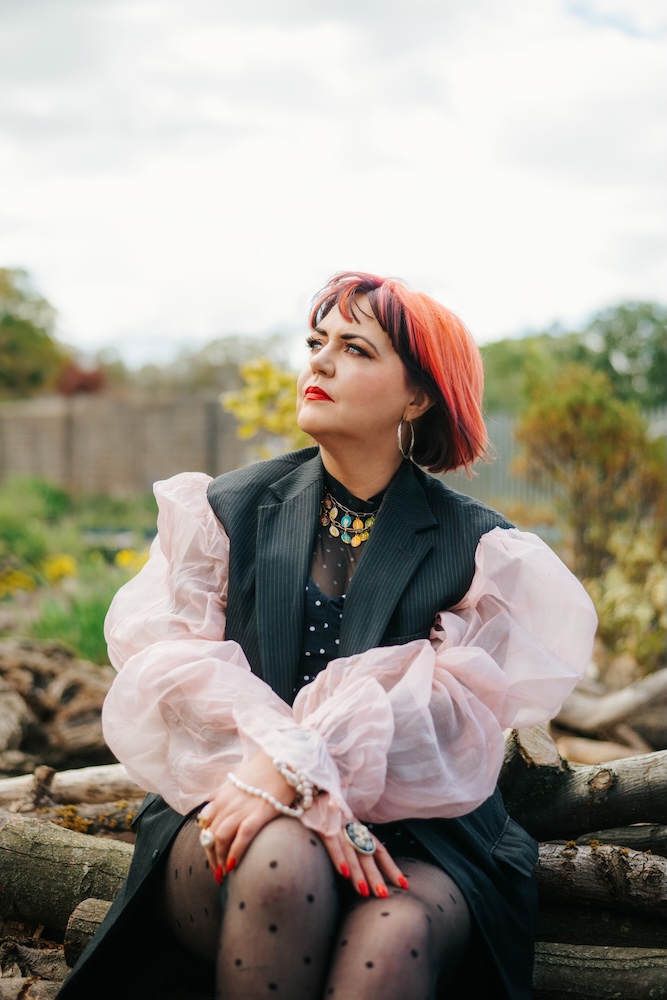
Hands Up for Trad’s Women in Music and Culture 2026 list has been announced to celebrate just some of the women working in Scotland.
Launched as part of International Women’s Day 2026, we shine the spotlight on 15 women who all contribute towards Scotland’s cultural landscape through their work. Read the 2026 list here.
We asked Michelle Burke to tell us more about their work, influences and ambitions for the future.
How did you first get involved in the arts and who were your early influences?
I grew up in East Cork. My dad had a band called The Aliens. I used to help load the trailer with the gear and go to watch them play. I loved the songs, the sticky dance floors, the otherworldliness of it all.
There were always singsongs at my grandparents’ house when I was small. Everyone had a song or a scéal. I had a Grand Aunty Peggy who was a formidable character, but when she sang she commanded the room. You’d be hung on her every note. Myself, my siblings, and cousins would be dying for her to sing. Those great characters left a big impression on me. I sometimes sing Aunty Peggy’s party piece now, and anytime I do I’m transported back to my granny’s living room. I can still smell the milking parlour out the back, the hairspray, the cigarettes.
I loved Maura O’Connell, Dolores Keane, the Irish countryside ballads that Delia Murphy sang. Dolly Parton. And the hymns — I’ve always loved a good hymn!
I sang in school, did local competitions, ballad groups, choirs. Played the piano. Studied music at University College Cork and the World Music Centre in Limerick. Spent my college summers down in Kerry working in hotels as a “piano driver”.
Before moving to Scotland, I spent a couple of summers singing in The Booley House, a local show in Co. Waterford.
I toured in the States for a few years singing with Cherish the Ladies. I learned a lot being on the road with the girls.
In a time when many artists and creative professionals are facing significant challenges, how have you developed and evolved your creative practice over the past few years?
I came to Scotland in 2004 for the craic for the summer — and I never left. My first show here was Step into My Parlour, which I put on for a full run at the Edinburgh Fringe. It all started with a bit of family detective work: my sister found our great grandmother’s old scrapbook in the loft, full of newspaper clippings, poems, songs, recipes, housekeeping tips and gas agony aunt columns from The Woman’s World. These were collected while my great grandad was a political prisoner on Spike Island during the War of Independence. There were poems too, written by my grand uncle Tom while he was imprisoned there — one of them stayed with me. There are postcards from Spike Island telling them all the news at home and asking them to send eggs and pencils. Many of the songs in the scrapbook were ones we learned in primary school. My friend Cathal McConnell, a traditional singer, was always encouraging me to sing those songs.
What began as a bit of craic grew arms and legs. I recorded the Step into My Parlour album, returned to the Fringe as part of Made in Scotland, and brought the show to India, Europe, and Ireland. Along the way, we often had special guests step into the parlour — one year at Celtic Connections, Duke Special joined us. When I started planning a new record, I asked Duke if he’d produce it. That became Mind How You Go, a studio album. We set my grand uncle’s prison poem to music for it.
When the pandemic hit, I had time to think about what I wanted to do next. I decided to develop the songs into a music-theatre show, again self-produced, with Gerda Stevenson directing. Loads of sleepless nights, wondering if I was off my head. It had its world premiere at Edinburgh Fringe last year.
Alongside this, I’ve spent years developing a dementia-inclusive theatre practice, working independently and with others, including three shows I’ve created with director Gerda Stevenson and musician James Ross for Capital Theatres in Edinburgh — The Hillman Hunter, The Christmas Box, and Jack in the Box. James and I tour them together. They’re carefully crafted to be playful and interactive, but always shaped by what happens with the people in the room. No two performances are ever the same.
Who or what interests you creatively?
I’m interested in the people I grew up around — real characters, contradictions, the things that don’t fit neatly. I’m curious about objects and the way they hold stories. My Granny Griffin’s rosary beads — I still carry them, even though I don’t go to mass anymore. The photos on the mantelpiece. There’s the one of Great Uncle Pat boarding a plane in San Francisco in his dickie bow and tuxedo.
He had sent my Grandad Albert — who couldn’t drive — a cheque to buy a car so he could show his children off around Ireland. A Hillman Hunter sat on the road outside my grandad’s house for months, waiting for the American cousins to arrive. It wouldn’t budge. My mam, aunts, and uncles would squash into the car and pretend to go places — it planted seeds, opened up a world of wonder. Then, on the very day Neil Armstrong landed on the moon, the Yanks finally arrived with their beautiful teeth and magazine hair. The world the Hillman Hunter had been holding finally had wheels.
I’m drawn to the collision of worlds. The glamour of Angela Lansbury in our parish, watching Murder She Wrote with my granny on the telly. And then people piling into cars to go on a pilgrimage to Ballinspittle or Mount Melleray to look at the moving statues — though Holy Mary never budged for me.
And I suppose the in-between spaces. I’m from a line of people like Uncle Pat, who left. A foreigner in Scotland, but somehow a visitor when I go home. Carrying invisible luggage — that grá for home never goes away.
What are your plans for the next year or so and/or what are your longer term creative ambitions?
The Mind How You Go studio album comes out this summer, and I’ll be bringing the show to Ullapool as part of the Feis Rois fringe programme on 1st May with more dates to be announced.
I’ll be developing a new dementia-inclusive show this year.
And I’m exploring something different — a new show. Early days, but I’m curious where it might lead.
Find out more about Michelle Burke here.
Read the Hands Up for Trad’s Women in Music and Culture 2026 List
Hands Up for Trad are an organisation who work with Scottish traditional music, language and culture. If you would like to support our work you can donate here.