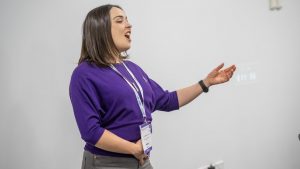
Hands Up for Trad’s Women in Music and Culture 2026 list has been announced to celebrate just some of the women working in Scotland.
Launched as part of International Women’s Day 2026, we shine the spotlight on 12 women who all contribute towards Scotland’s cultural landscape through their work. Read the 2026 list here.
We asked Kathleen Cronie to tell us more about their work, influences and ambitions for the future.
How did you first get involved in the arts and who were your early influences?
I started singing when I was 5 years old, and competed in the local Mòd on Skye. I’d clearly caught the performance bug as I persuaded my family to take me to sing at Mòds across Scotland every year, and I also took part in Fèisean in North Uist every summer holiday throughout my childhood. At that point I thought everyone did this – I had no idea that other kids weren’t spending their holidays learning concerts of Gaelic song!
I took voice lessons throughout my teens but as I reached university I didn’t yet have the confidence to pursue music as a career, and chose languages instead. I couldn’t quite leave the music world behind though and was pulled back in through conducting a Gaelic choir and taking part in Gilbert and Sullivan shows, choral societies, music theatre shows – really any group that would have me. In hindsight I was really spending more of my time performing rather than studying… Later I moved to London to retrain as an opera singer but the more I studied and the more auditions I endured, the more I felt that this was quite a lonely and stressful route to take. A casual comment from a friend one day reminding me that they’d really enjoyed a singing group I’d conducted really struck me, and I realised that the cure for musical loneliness was to find a role that couldn’t function without other singers in the room – conducting was really where my joy was.
I guess then that my influences have always been fairly varied, from local Gaelic singers, to musical theatre performers, to opera stars, and the teachers that have supported me to sing in such a wide variety of genres over the years.
In a time when many artists and creative professionals are facing significant challenges, how have you developed and evolved your creative practice over the past few years?
Depending on how you look at it, I was lucky or perhaps unlucky to be completing my PhD on choral singing during the COVID pandemic. Choirs couldn’t meet in-person, and singing was deemed too dangerous to be shared. Instead though, what I saw in my work was singers coming together online, sharing spaces and singing to each other in what became a new type of singing group – not a choir, but a group of people connecting through a shared need to communicate musically. This made me realise that my previous work which had more of a performance-focused approach was no longer what I felt was important, and brought me to focus more on what it is that brings folks together to sing. Turning then to work in community music was an easy choice. Since then, every project I’ve developed has focused on nurturing the experience for the people taking part – why is it that they’ve chosen to join this choir, or to take part in this project, as opposed to any other? This has led to such a strong focus on inclusion and listening to singers, that my practice now centres around this and my professional identity has really solidified in this area.
My interest now then is finding a space for authentic vocal expression for every singer. I’ve learned so much from menopausal singers about the emotional impact of vocal change on their lives, and this hammered home the importance of focusing on the relationship between voice and person, not person and product. In a similar vein, supporting trans people during their vocal transition has made me reflect on the wonderful possibilities of voice work – the range of possibilities in one person’s voice that aren’t always explored to their fullest. It’s also reaffirmed the importance of owning your voice and being able to express what you feel, want, and need to others with a voice that serves you authentically. Ultimately this makes the experience better for everyone involved. I don’t want anyone to think that a focus on individual singer-centred work or on inclusion is a niche, specialist endeavour. Instead, reflecting on ways to support singers has opened up my work to new projects and practices to share. My practice is thriving and I’m busier and more fulfilled than I’d envisioned being!
Who or what interests you creatively?
My absolute favourite thing to do is to find ways of fusing styles and influences together in new ways. This could be rearranging traditional songs with modern interpretations, scoring string quartets for a cappella singers, or introducing new genres to singers that they’ve never attempted before.
As a singing teacher, I feel strongly about breaking down the impression that songs need to be performed only in fixed ways, and helping students give themselves permission to sing new types of music. I hope that I give them the historical knowledge, and vocal skills to approach the repertoire with confidence and to appreciate the traditions such as opera or folk that we sing, but without prescribing one single ‘right way’ to sing to be considered performing these songs ‘properly’.
What are your plans for the next year or so and/or what are your longer term creative ambitions?
I think that, at the moment there’s a real lack of support for menopausal singers in Scotland. I’ve started compiling resources to help support through menopausal voice change but so many folks are experiencing this transition without knowing that vocal change is happening to so many singers around them at the same time. In the short term I’m delivering workshops and support sessions for voice users in choirs and workplaces and later this year I’ll be starting a Singing Through Menopause group. Longer-term I’d like to offer training for other song leaders to run these groups so that we can support singers across Scotland and the UK more widely.
I also want to bring the Scottish queer choral scene closer together. There are so many wonderful queer singers and groups – long term I’d love to see a queer choral festival here in Scotland, celebrating the community with a day of queer joy, song and performance.
Find out more about Kathleen Cronie here.
Read the Hands Up for Trad’s Women in Music and Culture 2026 List
Hands Up for Trad are an organisation who work with Scottish traditional music, language and culture. If you would like to support our work you can donate here.