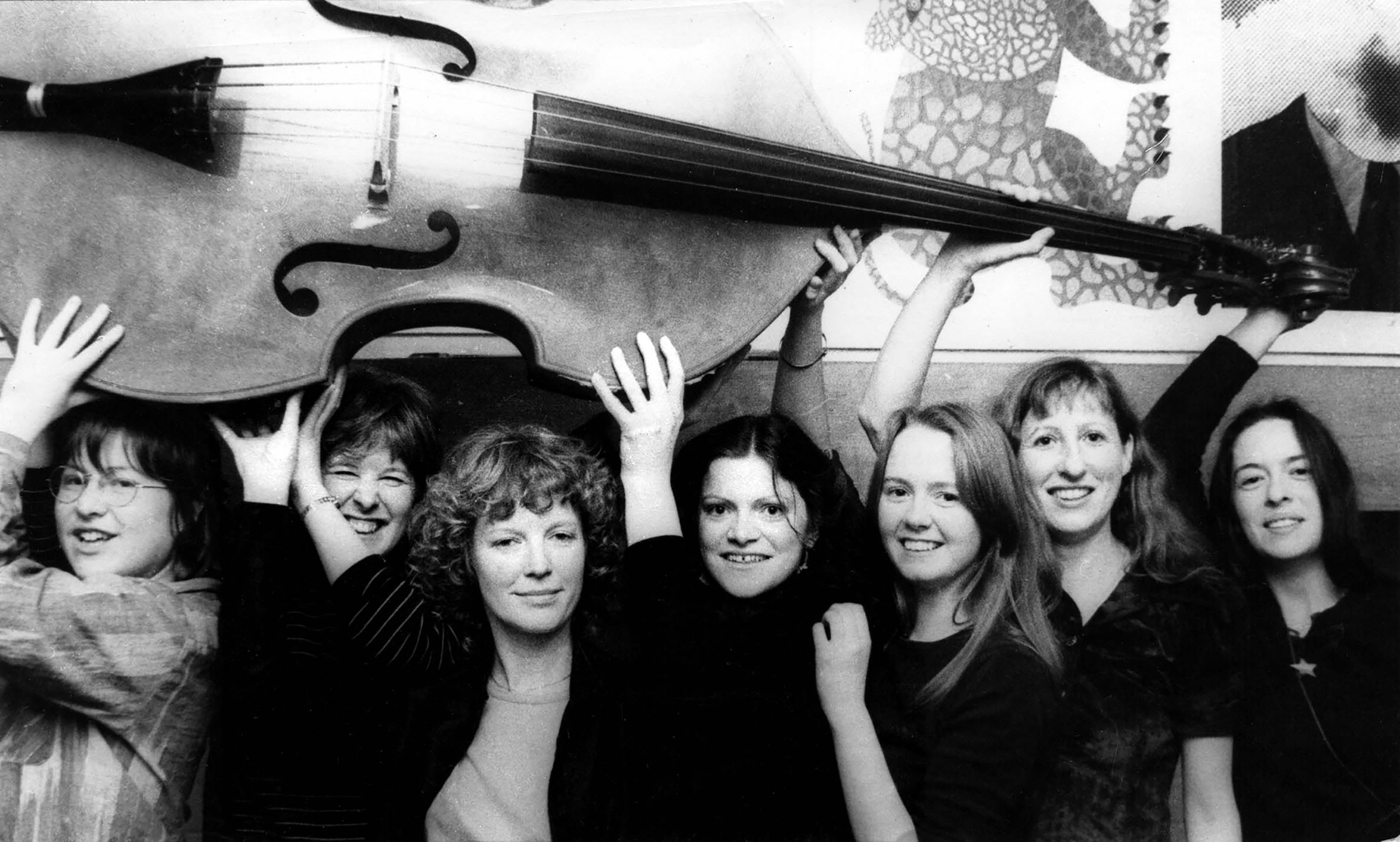
Formed in Edinburgh in 1982 for the Women Live in Scotland festival, Sprangeen brought a fresh and innovative voice to Scottish traditional music during a pivotal period in the folk revival. This all-women septet—comprising Kathleen King (double bass, fiddle), Marta McGlynn (concertina), Mary MacMaster (clàrsach, whistle, temple bells, vocals), Rosa Michaelson (fiddle, triangle, duck-call), Val Peek (fiddle), Patsy Seddon (clàrsach, fiddle, vocals), and Ann Ward (concertina, flute)—created a unique and imaginative sound that set a new tone within the Scottish folk scene.
What began as a special project for a single festival proved so successful that the band stayed together for another two years, becoming a distinctive presence on the Edinburgh music scene through their rousing concerts and ceilidhs. With their colourful clothes, cheerful presence, and joyfully creative approach to traditional music, Sprangeen cut a swathe through what had been a predominantly male-dominated scene, demonstrating that innovation and respect for tradition could coexist in perfect harmony.
Sprangeen’s instrumentation was both distinctive and versatile. Their combination of two fiddles, two metal and gut-strung Celtic harps, two concertinas, flute, whistle, and double bass—with one of the most innovative double-bassists around—created a varied and rich sound palette. The band occasionally incorporated unexpected elements, including Rosa Michaelson’s duck-call, adding moments of humour alongside their serious musicianship. This instrumental variety allowed them to explore different textures and arrangements, from delicate chamber-music sensibilities to robust dance-hall energy.
The band derived their style and repertoire from an impressively wide range of traditional roots. Their music stretched from the Borders to the Bothies and beyond, encompassing Gaelic waulking songs, Border fiddle tunes, Highland pipe music, traditional Scottish songs in both Scots and Gaelic, dance-hall reels and jigs, and slow airs from both sides of the North Channel. This breadth of material demonstrated their deep knowledge of Scottish musical traditions and their commitment to representing the full spectrum of the nation’s musical heritage.
Sprangeen specialised in subtle or startling arrangements that showcased both their musical skill and creative energy. They were young enough to experiment, but wise enough to respect the beauty of traditional music. Airs such as “The Braes of Lochiel” and “Miss Sine Flemington” were played with beautiful simplicity, allowing the inherent beauty of the melodies to shine through with accompaniments that enhanced rather than obscured. The band’s ability to glide seamlessly from the rounded beauties of the slow air “Miss Sine Flemington” (featuring flute, clàrsach, and bowed bass) into the muscular strathspey time of “The Ale is Dear,” which they then played as a reel, demonstrated their versatility and command of different Scottish dance rhythms.
Their innovative arrangements included a strathspey version of “Ale is Dear” and a mouth-music arrangement of “Paddy’s Leather Britches” that exemplified the innovation and spark which characterised Edinburgh’s music in the mid-1980s. They even performed a slow reel, “Flora Macdonald,” featuring clàrsach—an unusual and effective treatment of the tune. The band’s singing was equally accomplished, with Mary MacMaster’s waulking song particularly noted, along with the group’s vivacious port à beul (mouth music). There was no lack of variety when four members of the band could play fiddle on one track with two concertinas, creating rich, layered textures.
In 1984, Sprangeen recorded their first and only album, a self-titled collection that would prove to be an enduring contribution to Scottish traditional music. Alastair Clark of The Scotsman praised it as “an impressive recording debut,” noting particularly the excellence of the slow pieces and the quality of the singing. The album captured the band at the height of their creative powers, preserving their unique sound and innovative arrangements for future generations. Though the recording quality reflected its time and circumstances—small label meets seven-piece band in suboptimal surroundings—the musical content was undeniable.
The album’s release in 1984 established Sprangeen as pioneers who had set a new tone and brought a light touch to Scottish traditional music. Norman Chalmers of The List, reviewing the album’s re-release nearly thirty years later, awarded it four stars and described how the band had produced “a rumbustious, sometimes delicate, often amusing and always interesting take on their own country’s music.” The recording was featured as Archive Album of the Week on the Iain Anderson Show on BBC Scotland in August 2012, testament to its enduring quality and influence.
Although Sprangeen remained together for only two years, the individual members went on to make significant contributions to Scottish traditional music. The two clàrsach players, Mary MacMaster and Patsy Seddon, soon formed the duo Sileas, which became highly influential in its own right. They also became founder members of both The Poozies and Clan Alba, two groups that have had substantial impact on the Scottish music scene. Their singing and harping featured strongly on the Sprangeen recording, as did Patsy’s fiddling and Mary’s little-known mastery of oriental temple bells, demonstrating the breadth of their musical interests and abilities. Rosa Michaelson was also a member of the Angus-based Loose Moose Ceilidh Band in the late 80s, early 90s, who produced 1 CD on Lomoco Records.
In September 2012, to mark the thirtieth anniversary of the Women Live in Scotland festival, a reunion concert featuring a specially reformed Sprangeen took place at the Scottish Storytelling Centre in Edinburgh. The event was a great success, demonstrating the enduring affection for the band and the continued relevance of their music. The same year saw the re-release of their 1984 album on CD, introducing their music to a new generation of listeners and reminding older fans of the creative energy and musical skill that had been “knocking about the Edinburgh scene in the mid eighties.”
Alex Monaghan of Folk World described the re-release as “a welcome reminder” of that creative energy, noting that the album was “definitely worth hearing again.” The Footstomping website expressed delight at having the recording available on CD, praising how “Sprangeen brought a new dimension to the spectrum of Scottish music” with their unique instrumental combination and wide-ranging repertoire.
Sprangeen’s legacy extends beyond their recorded output and individual members’ subsequent careers. They demonstrated that an all-women ensemble could command respect and attention in a male-dominated scene, not through confrontation but through excellence, innovation, and joy in music-making.
Sprangeen’s induction into the Scottish Traditional Music Hall of Fame recognises their significant contribution to Scottish traditional music during a crucial period in its development. Their elegant collection of jigs, reels, traditional folk songs, and beyond stands the test of time, a testament to their musicianship, creativity, and deep understanding of Scotland’s musical heritage.