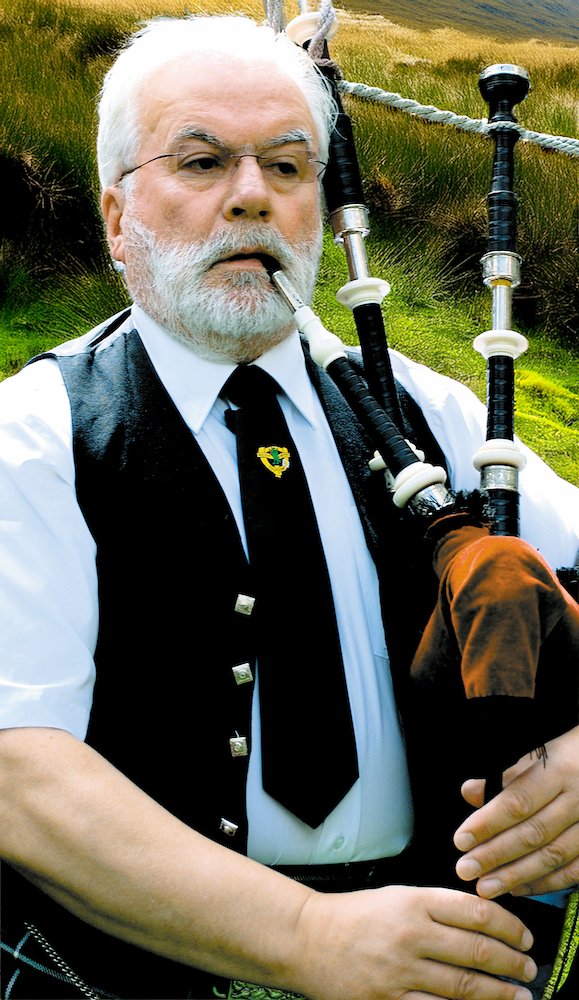
Born in Glasgow to parents from Great Bernera, just off the Isle of Lewis, Iain MacDonald spent most of his pre-school years on Bernera before his family moved to Glasgow when he was five years old. The family later settled in Barrhead on the outskirts of the city, where Iain would grow up immersed in the music that would define his life’s work.
Iain’s introduction to piping came naturally through family tradition. His maternal grandfather was a piper, as were several cousins and uncles, creating a rich musical heritage that surrounded him from childhood. He initially learned his piping through the Rover Scouts Pipe Band before advancing his studies with the renowned Duncan Johnstone, whose teaching would help shape his distinctive style.
During the early 1970s, Iain became an active participant in the folk scene revival that was transforming Scottish music. He joined several influential groups including the Battlefield Band, Tinkler Maidgie, and Kentigern, contributing his piping skills to the vibrant folk music landscape of the period. By the late 1970s, Iain’s talents and leadership abilities led to his appointment as Pipe Major of the Neilston & District Pipe Band, a position through which he would make lasting contributions to the pipe band movement.
In 1978, Iain led the Neilston & District Pipe Band on a memorable journey to Czechoslovakia, then still under Communist rule, to participate in the European/World Bagpipe Festival in the town of Strakonice. This trip proved particularly moving, as Iain later recalled playing in Wenceslas Square where people threw flowers into the middle of the band. Their courier translator explained that many in the crowd, particularly older people, remembered the sound of Scottish regiments marching through and liberating Prague. They held great respect for the kilts and uniforms they remembered from that time. Through Iain’s leadership, the village of Neilston gained an international profile that continues to owe everything to its pipe band.
Iain’s contributions to the wider piping community were significant and varied. In 1983, he was one of the pipers featured on Temple Records’ influential recording “A Controversy of Pipers,” a landmark album that showcased different approaches to traditional piping. He was heavily involved in the founding of the Lowland & Border Pipers’ Society, an organisation dedicated to promoting and preserving the distinct traditions of Lowland piping. Stuart Letford, the Society’s Convenor, recalled that Iain was one of the important figures during the early years of the LBPS’s formation and served at one point as its Vice Chairman. Many members still speak today of his remarkable collection of over thirty European pipes, a testament to his deep interest in the broader world of bagpipe traditions.
Iain was among the first pipers to perform Sir Peter Maxwell Davies’s “Orkney Wedding with Sunrise,” bringing the contemporary classical composition to life with traditional piping. Characteristically generous, he was known for loaning out his chanter to those who followed him in performing this challenging orchestral role, helping to ensure the piece could continue to be performed by others.
In his later years, Iain dedicated himself to passing on his knowledge and passion for piping to younger generations. He taught piping at the Music School at Williamwood High School and Carlibar School in Barrhead, ensuring that the traditions he had inherited and developed would continue to flourish.
Iain MacDonald’s induction into the Scottish Traditional Music Hall of Fame recognises his multifaceted contributions to Scottish piping—as a performer who bridged traditional and contemporary repertoire, as a leader who brought Scottish music to international audiences, as an advocate for Lowland piping traditions, and as a dedicated teacher who nurtured new generations of pipers.