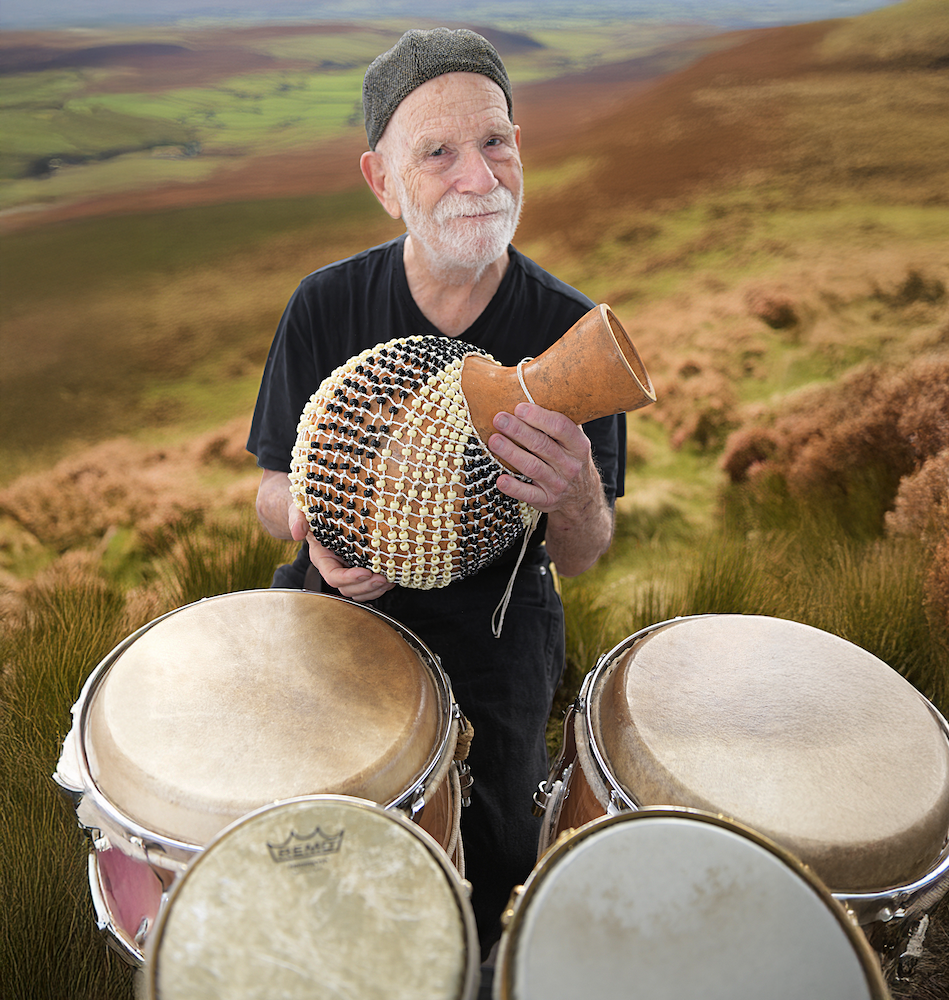
For more than three decades, Dr Steve Forman made a significant imprint on American recording and film music, working directly with many of the most established artists and film composers of his generation. His extraordinary discography includes hundreds of pop record projects, underscoring sessions for motion pictures, television shows, commercials, interactive titles, and theatrical events, establishing him as one of the most innovative and creative percussionists in the Los Angeles recording studios.
Forman’s professional credentials began in Arizona as a contract member of the Phoenix Symphony Orchestra, where he developed a strong foundation in classical percussion. However, his broader interests in music soon led him to the recording studios in Los Angeles, where he would make his most lasting impact. Interspersed with his early touring experience, Forman’s personal trips to Brazil and Japan proved to be important influences on his playing, exposing him to diverse percussion traditions and instrumental techniques that would shape his distinctive approach.
For percussionists, the study of music becomes a lifelong investigation of the world’s instruments, techniques, and styles. Forman’s pursuits led him to develop expertise across an remarkable range of musical forms including African styles, Afro-Cuban, Asian, bluegrass, Brazilian, Cajun, classical, country, Indian, jazz, gospel, hip hop, Middle Eastern, pop, rock, and techno. More recently, he devoted considerable attention to the bodhrán and traditional Celtic music, an interest that would later flourish during his years in Scotland.
Forman became recognised as one of the Los Angeles area’s most innovative and creative musicians, developing a distinctive style of “colour” hand percussion that extended well beyond the routine Latin instrument group common at that time. He expanded the on-stage instrument collection by utilising found objects like hubcaps and artillery shells, sculptural artefacts, and unusual metal and wood constructions. This creative approach to sound and texture became his trademark, opening up new sonic possibilities for composers and producers.
His extensive discography demonstrates the breadth of his work, having recorded with an impressive roster of artists including Christina Aguilera, The Beach Boys, David Benoit, Michael Bolton, David Bowie, The Cate Brothers, Rita Coolidge, Fleetwood Mac, Glen Frey, Amy Grant, Don Henley, Al Jarreau, John Lennon, Kenny Loggins, Loggins & Messina, Sergio Mendes, Pink Floyd, Poco, REO Speedwagon, Linda Ronstadt, James Taylor, and Jennifer Warnes, among many others. His versatility allowed him to move seamlessly between pop, rock, jazz, country, and world music projects.
Forman helped broaden the definition of percussion in film music as well. He was quick to incorporate digital samplers and signal processors as natural extensions to the acoustic sonic effects he was often called upon to create, developing a unique textural sound design concept. He was one of the first percussionists to use computers to drive and synchronise digital samplers with a live orchestra during real-time film scoring sessions, developing techniques to seamlessly blend electronic percussion with ethnic acoustic instruments. Often he worked directly with composers and directors to generate a sonic bridge between a picture’s musical score and its sound effects track.
His film credits as an orchestra member include major Hollywood productions such as E.T., An Officer and a Gentleman, Tootsie, Pretty Woman, Misery, The Last of the Mohicans, Starship Troopers, U-571, and Catch Me If You Can, among many others. He provided special percussion, percussion sequences, or sound design for films including Starship Troopers, Breakdown, Switchback, Payback, Godzilla, Dr Dolittle, Pirates of the Caribbean, and For Love of the Game, working with composers including Basil Poledouris, Bruce Broughton, Richard Gibbs, David Arnold, and Klaus Badelt.
In 1997, to make real percussion more accessible to composers self-packaging projects, Forman opened Tambourine Percussion Studio in Venice, California, a recording environment with a large resident collection of ethnic and orchestral percussion instruments. This facility allowed him to offer comprehensive percussion services to the film and recording industry whilst maintaining the highest standards of acoustic quality.
In 2003, Forman began a significant career transition from the recording studios in Los Angeles to focus on the study of composition at the California Institute of the Arts. Demonstrating remarkable dedication, he earned both a BFA and an MFA in composition in just four years, bringing his decades of practical experience to bear on formal compositional studies. This academic pursuit represented a new chapter in his musical life, allowing him to explore theoretical frameworks for the rhythmic and textural innovations he had developed through professional practice.
In September 2008, Forman joined the research department at the Royal Conservatoire of Scotland (RCS) in Glasgow, beginning a new phase of his career focused on education and research. He was awarded a PhD in composition by the University of St Andrews in 2011, with research that led to an expanded understanding of multi-dimensional polyrhythmic systems and high resolution synchronicity, semi-malleable forms, and non-standard instrumentation. His research drew upon more than three decades of professional practice, providing theoretical underpinnings for techniques he had developed in the recording studio.
In 2009, the Royal Conservatoire of Scotland initiated a choice module called Pulse Relational Rhythm Theory, based on insights emerging from Forman’s research and his extensive professional experience. This module allowed him to share his unique perspective on rhythm and timing with a new generation of musicians, bridging the worlds of commercial music production and academic music education.
Forman’s practice in Scotland included active participation in Glasgow’s vibrant folk music sessions, where his interest in traditional Celtic music flourished. He composed new concert works in a variety of genres and became a valued lecturer at the Royal Conservatoire of Scotland, teaching in the BMus Programme and Creative and Contextual Studies. His four years at the institution allowed him to make significant contributions to the development of young musicians whilst remaining active as a composer and performer.
In 2014, Forman faced immigration difficulties when he could not extend his visa due to salary restrictions, as he could not meet the minimum salary requirements for a Tier 2 visa specified by UK government regulations. Despite having been in the UK for more than seven years and having taught at RCS for four years, his application for leave to remain was refused by the Home Office. The case attracted considerable attention, with the Scottish Government calling on the Home Office to reconsider, stating that “the talent and expertise of people such as Steve Forman make a welcome contribution to developing Scotland’s future musical talent.” A change.org petition for the reinstatement of his work visa attracted nearly 1,500 signatures, demonstrating the widespread support for his continued presence in Scotland.
Forman’s solicitor described the case as “truly exceptional,” stating that the Home Office had “clearly failed to give proper consideration to his individual rights and the rights of the community which he is a valued member of.” Forman himself stated: “I would like to see the UK Border Agency look at the value gained and the value lost from me leaving Scotland when I am contributing full-time to society on many different levels. I am in the community playing traditional music with some of the finest musicians I have ever heard. I would like to stay involved with life and I would like to do this in Scotland where I live, where my friends are and where my family is.”
Dr Steve Forman’s induction into the Scottish Traditional Music Hall of Fame, with his unique journey from the Hollywood recording studios to the folk sessions of Glasgow exemplifies the universal language of music and the value of bringing diverse experiences and expertise to traditional music. His decades of work at the highest levels of the music industry, combined with his academic research and his embrace of Scottish traditional music, represent a remarkable career dedicated to exploring the possibilities of percussion and rhythm across all musical boundaries.