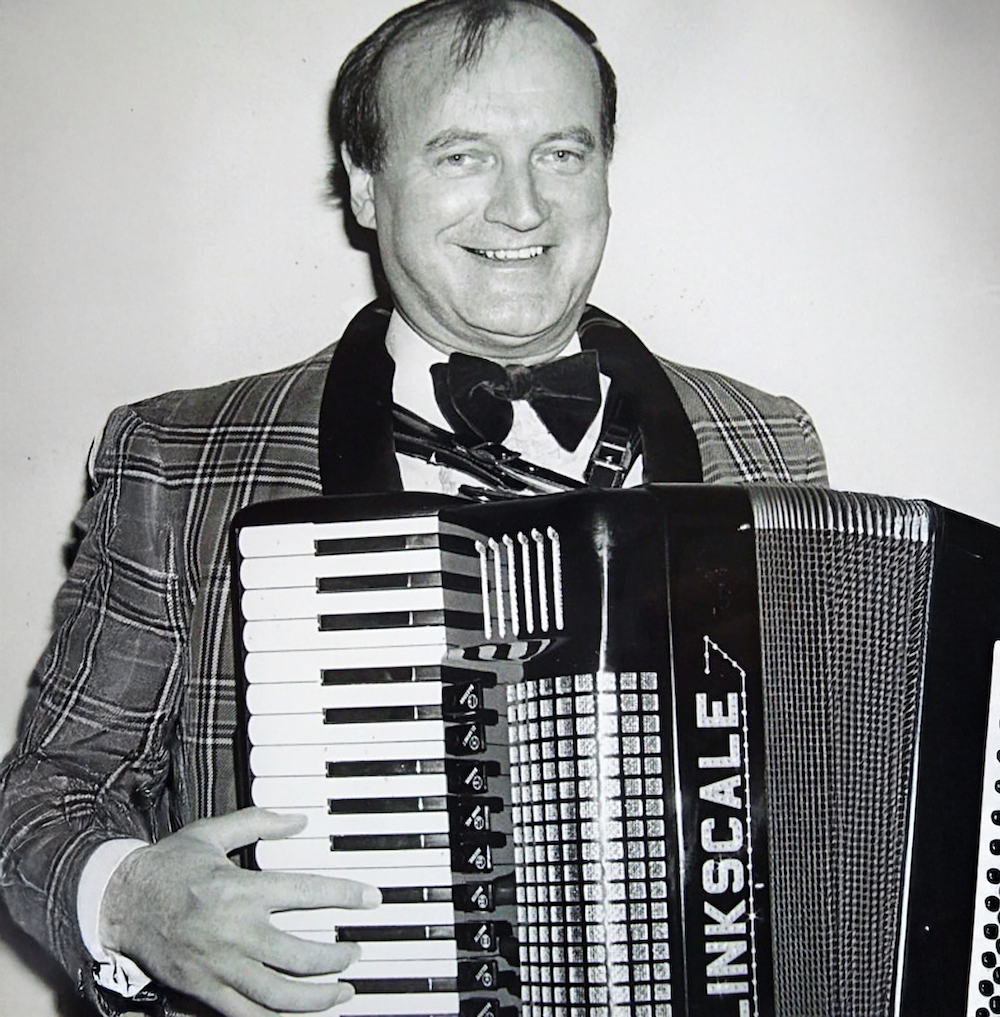
Born in Torry, Aberdeenshire, Andrew Rankine moved with his family to Menstrie, Clackmannanshire when he was two years old. It was in this small Hillfoots village that he would develop into one of Scotland’s most accomplished accordionists and dance band leaders, dedicated to preserving and performing Scottish dance music with both authenticity and innovation.
Andrew’s first musical experience came as a drummer in a local pipe band, giving him an early grounding in rhythm and ensemble playing that would serve him well throughout his career. However, it was at the age of sixteen that he discovered his true musical calling when he began learning the piano accordion. His natural aptitude and fierce dedication were immediately apparent—within just a year of taking up the instrument, he had formed his first band, demonstrating both his musical confidence and his understanding that Scottish dance music was fundamentally a communal, social art form.
Andrew’s early influences were the giants of Scottish dance music: Jimmy Shand and Bobby MacLeod. He was disappointed to discover, after learning to play piano accordion, that his hero Jimmy Shand actually played a button box. Nevertheless, Andrew pursued his chosen instrument with remarkable discipline and determination. He undertook two years of practical instruction and four years of music theory, but it was his personal practice regime that truly set him apart. He devoted four hours every weekday to practice, extending this to eight hours on Saturdays and Sundays—an extraordinary commitment that built the technical foundation for his later success.
Andrew was a keen and attentive listener to Scottish dance music in all its available forms. He collected 78rpm records, listened avidly to broadcasts on radio, and attended live performances at the Cochrane Hall, where many of the era’s finest bands performed. Sometimes he would be honoured to be asked to play during intervals with his friend Jack Delaney, gaining valuable experience before eventually securing actual engagements there with his own band. His ensemble included exceptional musicians: Archie Nicol on fiddle, John McIntosh on piano, Bert Shorthouse on second box, and Stan Saunders on double bass, among many other fine musicians, some of whom went on to form their own bands. At one point, all the rhythm section in his band were jazz players, bringing a sophisticated harmonic understanding and rhythmic flexibility to traditional Scottish dance music—a creative fusion that enriched the music whilst maintaining its essential character.
During Andrew’s thirty-eight-year career, he witnessed and adapted to many changes in the Scottish dance music scene. One of the most significant was the addition of electronics to traditional instrumentation. As part of his work with Selmers, the music instrument company, Andrew demonstrated the Cordovox electronic accordion, showing his willingness to embrace new technology whilst remaining true to traditional repertoire and style. The popularity of rock and roll in the 1960s dramatically changed the local dance hall scene, presenting both challenges and opportunities for Scottish dance bands. Andrew navigated these changes whilst maintaining his commitment to the essential character of Scottish dance music.
Andrew’s passion for Scottish dance music was profound and enduring. He loved playing, composing, and listening to the music, whether in Clackmannanshire or California. Playing was not merely a profession or a pastime but a source of deep personal comfort—in moments of stress or sadness, he would reach for his accordion, finding solace and expression through the music. He loved his Scottish culture and took great pride in it, becoming a splendid ambassador for Scotland during his time in the United States.
Before emigrating to the USA in 1983, Andrew had made a couple of recordings in his own studio in Leicester, demonstrating his interest in the technical side of music production as well as performance. He hoped to continue this recording work in Southern California, where he found a welcoming community of people of Scottish descent. He had already played for several Royal Scottish Country Dance Society branch dances, bringing authentic Scottish dance music to expatriate communities eager to maintain their connection to home. Two of his last compositions—”Mr. and Mrs. Robert Patterson” and “The Calican Scot”—were written for members of these communities, demonstrating his generosity in creating music that celebrated the people and occasions that mattered to him.
Andrew settled in Southern California, where he continued to perform and became particularly associated with The Queen Mary in Long Beach, the retired ocean liner that had become a permanent attraction and venue. There, he served as a proud ambassador for Scotland and Scottish culture, sharing the music he loved with audiences who might otherwise have had little exposure to authentic Scottish traditions. His presence in California demonstrated that Scottish dance music could travel and find new audiences whilst retaining its essential character and connection to home.
Andrew’s philosophy about music was refreshingly straightforward: enjoy it. Find a nice tune and play it well. This simple principle guided his approach to both performance and composition, emphasising musicality and communication over technical display, and joy over pretension. It was a philosophy that served him well, creating music that brought pleasure to dancers and listeners whilst maintaining the highest standards of musicianship.
Andrew Rankine passed away in December 1984, having devoted nearly four decades to Scottish dance music. Though his life was cut short, his legacy endures through his compositions, recordings, and the many musicians he influenced and inspired. His dedication to practice, his willingness to embrace both tradition and innovation, his warmth as an ambassador for Scottish culture, and above all his pure love for the music itself exemplify the best qualities of Scotland’s dance band tradition.
Andrew Rankine’s induction into the Scottish Traditional Music Hall of Fame recognises his significant contributions as an accordionist, bandleader, composer, and ambassador for Scottish dance music, ensuring that his name and his music will continue to be celebrated by future generations of musicians and dancers who share his love for this vital Scottish tradition.